Behavioral and document signals
Official descriptions mention suspicious answers, behavior that deviates from protocol, slurred speech, and paperwork that can appear suspiciously perfect. The demo update adds concrete document risks: incorrect passport or pass numbers and fake medical certificates. These signals give you a reason to compare more evidence; they are not guaranteed one-step labels for every visitor.
- Listen for answers that conflict with the stated identity, role, or purpose.
- Compare actions with the protocol described in the current manual.
- Read long numbers carefully instead of judging the overall document design.
- Re-check unusually flawless papers against identity and physical evidence.
Physical and identity signals
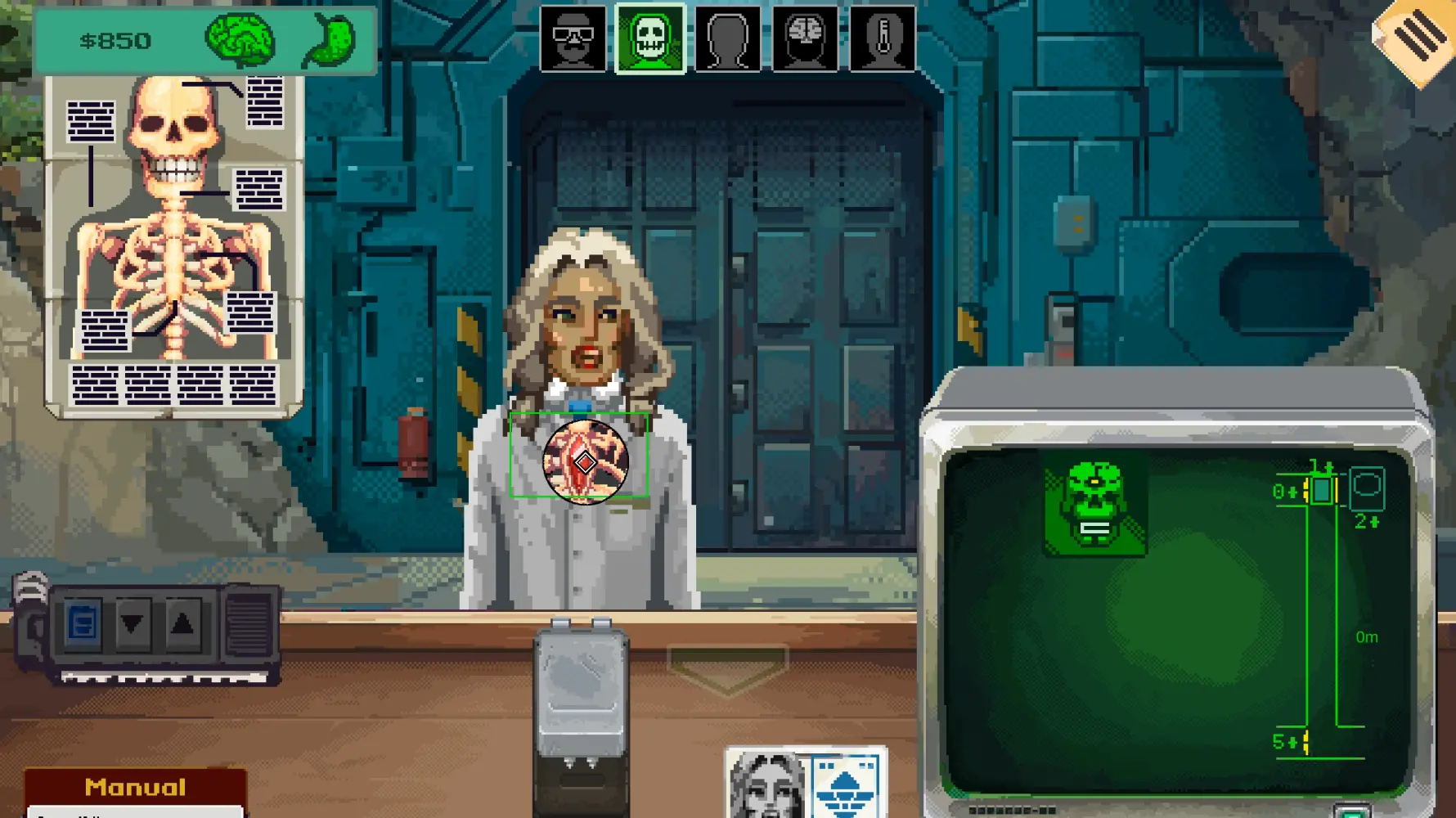
Alawar confirms taking employee photographs, X-ray inspection, examination of internal organs, body temperature, visible skin inflammation or anomalies, fingerprints, and blood testing. An official full-version announcement also mentions blood sample analysis and microscopic examination of suspicious specimens.
Public sources do not publish exact temperature cutoffs, blood values, sample formulas, or a complete list of internal irregularities. Use each method to seek corroboration and follow the current in-game instructions rather than importing an unsupported threshold from a discussion post.
Officially shown anomaly examples
Alawar's current game page describes an elevator returning from the lower levels that registers as empty across the camera system. When its doors open, however, a person is standing inside. The useful evidence is the direct conflict between the monitor record and what appears at the checkpoint.
The same official page describes an employee who has already finished work and gone home, then later rises from the underground facility carrying the same papers and identity. That duplicated return conflicts with the movement record even before any physical inspection begins.
These are officially described scenarios, not named anomaly entries. They confirm that camera context, entry and exit history, identity, and documents can contradict one another; they do not establish anomaly names, tiers, rarity, or a fixed correct action.
General player-facing inspection advice
The following workflow is general inspection advice, not an official fixed answer to either example. Preserve the initial contradiction, re-check the current movement record and papers, then choose a targeted identity or physical method that can test what remains uncertain.
A disciplined decision moves from basic checks to stronger ones: establish the contradiction, identify which available tool can examine it, and use quarantine only when unresolved risk warrants containment under the current in-game instructions. One camera inconsistency or repeated identity is a reason to investigate, not permission to invent a universal outcome.